
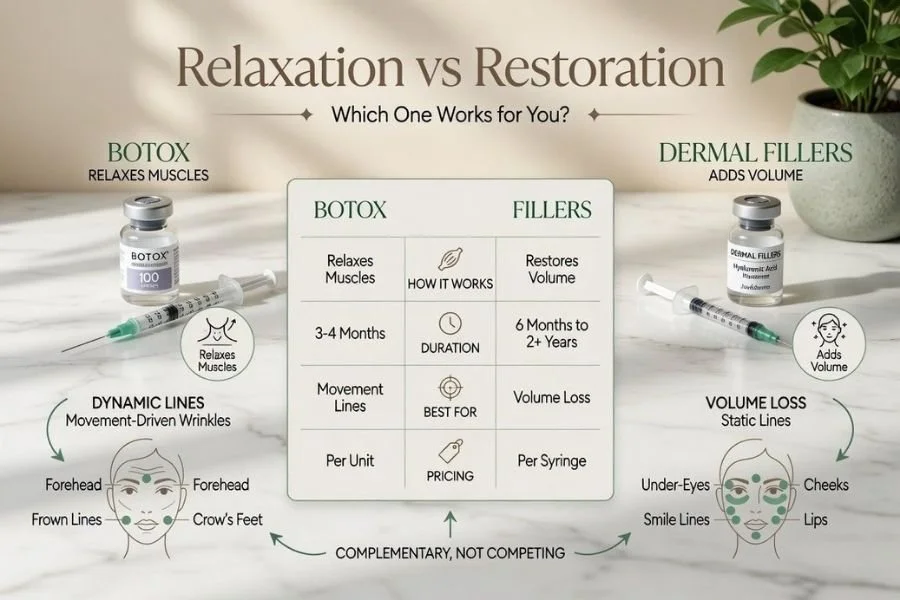
Botox and dermal fillers get grouped together constantly, but they do almost opposite jobs. One relaxes muscles to soften the lines your expressions create; the other adds volume to restore fullness your face has lost. Choosing between them really comes down to which problem you're trying to solve.
At Skin Theory Aesthetics, we offer both Botox and dermal fillers, so this isn't about steering you toward one. Here's how they differ, what each does best, and how our Nurse Practitioner decides which one — or both — fits your goals.
Botox vs Fillers: The One-Line Difference
Botox relaxes muscles. Fillers add volume. That's the whole distinction in a sentence, and it explains everything else.
Botox treats dynamic wrinkles — the lines that appear when you move your face, like frowning or squinting. Fillers treat static concerns — volume loss and folds that are there even when your face is at rest. Knowing which type of line is bothering you usually points to the right treatment.
What Botox Is Best For
Botox is the answer for movement-driven lines in the upper face: forehead lines, the frown lines between the brows, and crow's feet at the corners of the eyes. It works by temporarily relaxing the muscles that crease the skin, so those lines soften.
It won't restore lost volume or lift sagging skin — that's not what it does. But for expression lines, and for things like a subtle brow lift or masseter Botox for jaw tension, it's the right tool.
What Dermal Fillers Are Best For
Fillers restore fullness where the face has lost it. Made largely from hyaluronic acid — the same substance your body produces naturally — products like Juvéderm and Restylane plump and re-contour rather than relax.
They're used for the mid and lower face: thinning lips, flattened cheeks, under-eye hollows, and deeper folds like smile lines. Where Botox quiets movement, fillers rebuild structure.
Botox vs Fillers at a Glance
| Factor | Botox | Dermal Fillers |
|---|---|---|
| How it works | Relaxes muscles | Adds volume |
| Best for | Dynamic movement lines | Volume loss, static lines, contour |
| Common areas | Forehead, frown lines, crow's feet | Lips, cheeks, under-eyes, smile lines, jawline |
| Results last | 3–4 months | 6 months to 2+ years |
| Onset | Builds over ~2 weeks | Immediate, settles in days |
| Typical pricing | Per unit | Per syringe |
How Long Does Each Last?
Botox is shorter-lived. Results last about three to four months before a maintenance treatment is needed, since the muscle gradually regains movement.
Fillers last longer. Depending on the product and area, results run anywhere from six months to two years or more. That longevity is one reason fillers are priced differently — you're treating less often.
Cost: Which Costs More?
The two are priced in different ways. Botox is charged per unit, so a treatment's total depends on how many units your areas need. Fillers are charged per syringe, and some areas need more than one.
Botox usually has a lower upfront cost per session, but it's repeated more often; fillers cost more per session but last longer. For real per-unit numbers, our Botox cost guide for Mount Kisco breaks it down by area.
Can You Get Both Botox and Fillers?
Yes — and many patients do. The two are complementary, not competing: Botox can soften forehead and eye lines while filler restores cheek or lip volume, for a result that looks refreshed rather than "worked on."
When both are part of a plan, the sequencing and dosing matter, which is exactly the kind of thing worth mapping out at a consultation rather than deciding on the fly.
So, Which Is Right for You?
Start with the concern. If it's lines that show up when you move your face, Botox is likely the answer. If it's lost volume, flatter cheeks, thinning lips, or deeper folds at rest, fillers are the better fit. Often the most natural result combines a little of each.
Because we offer both, our board-certified Nurse Practitioner — with 18 years of clinical experience, including a decade in dermatology — recommends based on your anatomy and goals, not on what we'd rather sell. If you're also weighing neuromodulators, our Botox vs Dysport guide covers that side.
A Note on Safety
Both are very safe in trained hands. Botox's common effects are minor and temporary — small bruises, mild swelling, occasional headache. Fillers share those, with a rare but more serious risk if product enters a blood vessel, which is precisely why injector skill and facial-anatomy knowledge matter so much. We use FDA-approved products and review your history before treating.
Botox, Fillers, or Both — Let's Map It Out
The right choice starts with your goals, not a label. Skin Theory Aesthetics offers Botox and dermal fillers, transparent pricing, and the same experienced Nurse Practitioner at every visit.
Frequently Asked Questions
What's the main difference between Botox and fillers?
Botox relaxes muscles to soften movement lines; fillers add volume to restore fullness and contour. Different problems, different tools.
Do fillers last longer than Botox?
Yes. Botox typically lasts three to four months, while dermal fillers last from six months to two years or more depending on the product.
Are Botox and fillers more expensive together?
Combining them costs more than either alone, but it can deliver a more balanced result. Your plan and estimate are confirmed at consultation.
Which is better for forehead lines?
Botox — forehead lines are caused by muscle movement, which is exactly what Botox addresses. Fillers wouldn't be the right tool there.
Can I get Botox and fillers at the same appointment?
Often yes, depending on the areas and plan. Your provider will advise on whether to do them together or stage them.
Is one safer than the other?
Both are safe with a qualified injector. Fillers carry a slightly higher risk profile because they're placed in tissue, which is why provider experience is key.