
How Long Does Botox Last? Complete Wear-Off Guide
BOTOX Cosmetic (onabotulinumtoxinA) typically produces visible improvement for roughly three to four months, although the exact timeline varies. The FDA prescribing information lists an approximately three-to-four-month effect for glabellar frown lines, while official BOTOX Cosmetic information says results for forehead lines, frown lines and crow's feet can last up to four months.
That does not mean your face stays exactly the same for four months and suddenly returns to baseline. Botox wears off progressively.
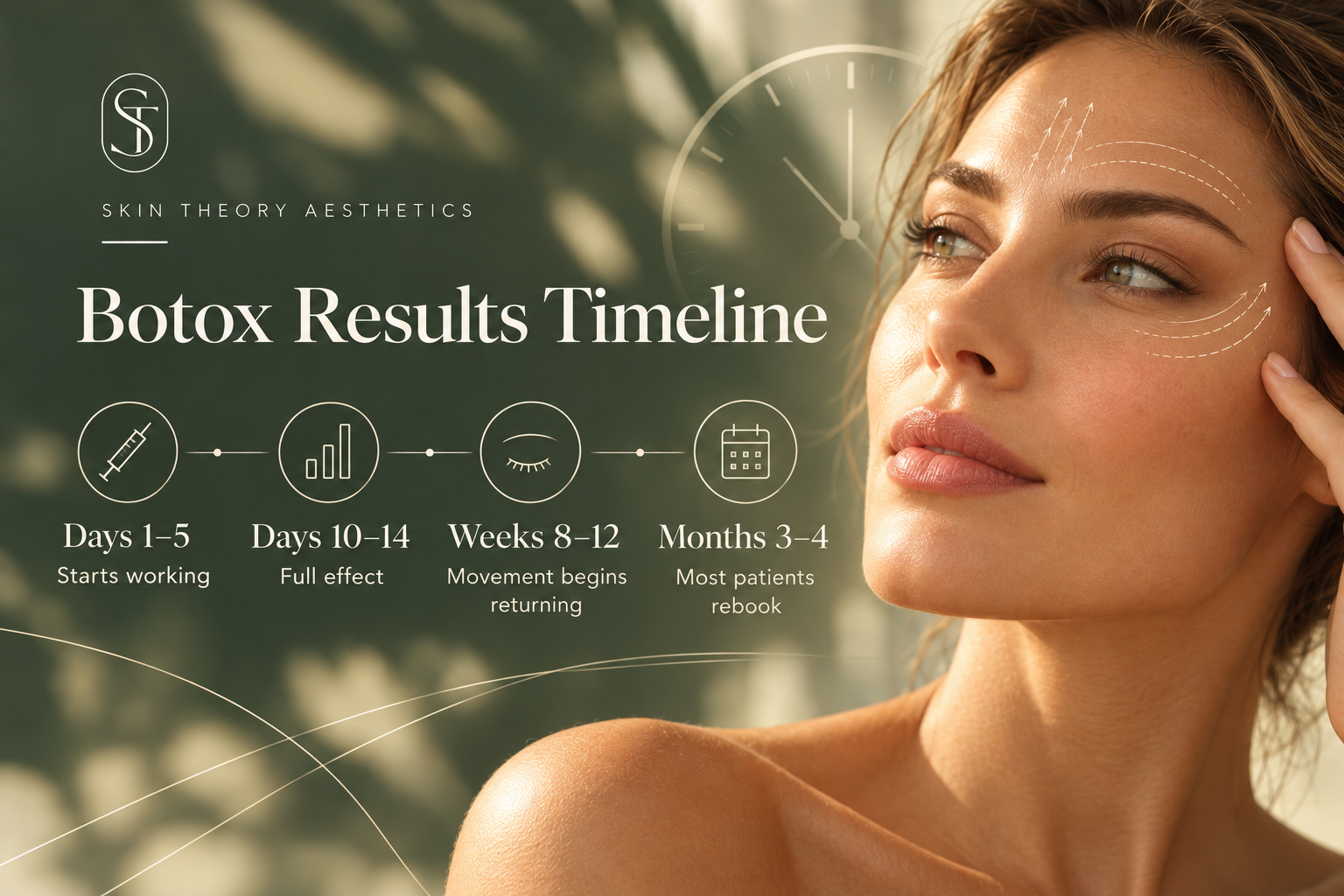
Quick Botox Results Timeline
A useful Botox results timeline separates when the treatment starts working from when it is fully worn off.
| Stage | Typical Timing | What You May Notice |
|---|---|---|
| Initial effect | Days 1–5 | Subtle softening; some patients notice reduced movement within 24 to 48 hours |
| Peak / full effect | Days 10–14 | Maximum muscle relaxation; treated lines at their smoothest |
| Gradual fade begins | Weeks 8–12 (varies widely) | Small amounts of movement start returning; lines may become faintly visible with expression |
| Substantial return of movement | Months 3–4 (approximately) | Treated muscles contracting more noticeably; most patients consider rebooking |
| Return to pre-treatment baseline | Varies; may extend beyond 4 months | Lines and movement close to pre-treatment state |
These stages do not happen overnight. There is no single day when Botox "stops working." Most patients experience a gradual transition, which is why rebook timing is more useful as a range than as a fixed date.
How Long Does Botox Last in Different Areas?
Patients searching how long does Botox last in the forehead or how long does Botox last for crow's feet often find very specific numbers online. The evidence is more nuanced.
For glabellar lines between the eyebrows, the FDA prescribing information gives an approximate duration of three to four months. For forehead lines and crow's feet, official BOTOX Cosmetic information states that results can last up to four months.
| Treatment Area | Typical Duration Range | FDA-Approved Cosmetic Use? | Important Note |
|---|---|---|---|
| Glabellar (frown) lines | 3–4 months | Yes (corrugator / procerus muscles) | Most studied area; most reliable duration estimate |
| Crow's feet | 3–4 months | Yes (lateral canthal lines / orbicularis oculi) | May appear to fade earlier in patients with strong squinting habits |
| Forehead lines | 2–4 months | Yes (frontalis muscle) | Often intentionally under-dosed to prevent brow heaviness, lighter dosing shortens duration independently of metabolism |
| Platysma bands (neck) | 3–4 months | Yes (added to FDA label) | Less common cosmetic use; evidence base smaller than upper face |
| Masseter (jaw) | 4–6 months | No (off-label) | Larger muscle, typically higher dose; evidence from smaller studies; functional relief may differ from cosmetic timeline |
| Lip flip | 6–10 weeks | No (off-label) | Very small dose into orbicularis oris; shorter duration expected; not comparable to wrinkle treatment |
BOTOX Cosmetic is also currently FDA approved for platysma bands in the neck. Masseter injections and Botox lip flips are different because they are off-label cosmetic uses, so their dosing, goals and duration evidence should not be treated as though they are identical to FDA-approved upper-face treatments. For a detailed comparison of BOTOX Cosmetic and Dysport for these areas, see our Botox vs. Dysport guide. Units are not interchangeable between products.
Why Does Botox Wear Off? The Mechanism
OnabotulinumtoxinA works by temporarily blocking the release of acetylcholine at the neuromuscular junction, the point where a nerve tells a muscle to contract. Over time, the body responds by sprouting new nerve endings that eventually re-establish signaling.
As those new connections form, muscle contraction gradually returns. This process, rather than the metabolism of the toxin molecule itself, is the primary reason Botox duration is finite and why wear-off is gradual.
This mechanism explains something patients often find confusing: you can feel small amounts of movement returning while the area still looks relatively smooth. The return of some muscle activity does not mean treatment has failed, it means the nerve is starting to recover. Visible lines typically become more apparent a few weeks after movement begins returning.
What Does It Look Like When Botox Starts Wearing Off?
If you are wondering when does Botox wear off, look for gradual changes rather than a sudden switch.
A small amount of muscle movement may return first. As muscle movement returns, dynamic wrinkle lines can gradually become more visible during frowning, smiling, or raising the eyebrows. As nerve-to-muscle function continues recovering, movement increases and the treated area moves progressively toward its pretreatment pattern.
FDA glabellar-line trials show this progression clearly. Investigator-assessed responder rates decreased from 80% at day 30 to 70% at day 60, 48% at day 90 and 25% at day 120. That illustrates why returning movement does not necessarily mean the entire treatment effect has disappeared.
Stopping treatment does not mean your face suddenly rebounds into worse wrinkles because Botox was withdrawn. Muscle activity returns and expression lines become visible again, while normal skin aging continues.
Why Does Botox Last Longer for Some People?
There is no single Botox duration for every patient. Dose is one meaningful factor. Research on forehead treatment has demonstrated a dose-response relationship in both treatment response and relapse toward baseline. Treatment area, muscle strength, anatomy and the degree of relaxation being targeted can also influence how a patient experiences the treatment.
Treatment goals matter too. Someone who wants strong reduction in muscle movement may judge the treatment as “worn off” as soon as noticeable movement returns. Someone who intentionally preserves more expression may judge duration by when the wrinkle improvement itself has substantially faded.
This is also why “I have a fast metabolism” is not a sufficient medical explanation for a short result. Botulinum toxin metabolism and termination of action are complex, and published research does not support reducing individual duration to a simple fast-versus-slow metabolism rule.
Does Botox Last Longer After Repeated Treatments?
Not reliably enough to promise it.
Research does suggest that repeated onabotulinumtoxinA treatment can produce cumulative improvements in resting glabellar lines. However, that is not the same as proving that every future injection remains pharmacologically active for longer.
In one repeated-treatment study, the duration did not increase across treatment cycles. A longer-term study found benefits that persisted after repeated treatment, but those findings concern wrinkle improvement and should not be translated into the blanket claim that Botox “lasts longer every time.”
So if you are researching how long does Botox last first time, a shorter first treatment is possible, but it should not be presented as a rule that applies to everyone.
Can You Make Botox Last Longer?
There is no proven trick that dramatically extends Botox. Here are some options for better clarity.
| What Likely Matters for Duration | What Does Not Extend the Effect |
|---|---|
| Appropriate dosing for your muscle strength and treatment goal: the single most influential variable within provider control | Drinking more water: hydration supports skin health generally, but no evidence it prolongs neuromuscular blockade |
| Consistent treatment schedule: muscles that are regularly relaxed may gradually become less dominant | Facial moisturizer / skincare products: maintain skin quality but do not affect nerve-muscle signaling |
| Treating when movement starts returning rather than waiting until results are fully gone: often keeps less product needed per session | Zinc supplements: proposed in some aesthetic forums; no well-controlled clinical evidence that oral zinc extends BOTOX Cosmetic duration |
| Provider expertise in injection placement: well-placed product works more efficiently | Avoiding all facial expressions: impractical; not supported as a meaningful duration factor |
| Sun protection and skin care: does not directly extend Botox's effect, but helps skin look better between treatments | Stress reduction / sleep: important for overall health; no clinical evidence directly linking them to Botox pharmacologic duration |
The most important distinction: good skincare makes your skin look better. It does not change how quickly your nerves regrow or how quickly muscle activity returns. These are separate processes. A provider who tells you sunscreen "makes Botox last longer" is conflating the two.
When Should You Get Botox Again?
For patients asking how often you should get Botox or how long between Botox treatments, there should not be one automatic calendar date for everyone.
BOTOX Cosmetic treatments should be spaced at least 90 days apart, and the FDA prescribing information notes that treatment more often than every three months has not been clinically evaluated.
After that minimum interval, timing should reflect the return of movement, treatment area, desired level of expression and your provider's assessment. There is no need to chase complete immobility.
When Botox Seems to Wear Off Too Fast
If results seemed to disappear within six to eight weeks, consider a few things before assuming treatment failure:
Full peak results take 10–14 days. Evaluating at one week is too early.
Forehead treatments are commonly under-dosed on the first visit to assess response and avoid brow drop, shorter duration in this area on your first treatment is often intentional, not a product issue.
Dose may need adjustment for your specific muscle strength, this is calibrated over two or three appointments at a new practice.
High physical activity may be a contributing factor based on emerging evidence.
If results consistently last only 6–8 weeks despite appropriate dosing and treatment interval, that is worth discussing with your injector. There are rare cases of antibody-mediated resistance to botulinum toxin, particularly with very frequent treatments or high cumulative doses, though this is uncommon at cosmetic doses.
Skin Theory Aesthetics provides Botox treatment in Mount Kisco, NY, through a board-certified Nurse Practitioner-led practice. Patients who want to understand their own treatment timeline can schedule a consultation to discuss movement, treatment goals and appropriate maintenance rather than relying on another person's schedule.
Frequently Asked Questions
Can Botox last six months?
Yes, Botox can last up to six months in some patients or treatment areas, but this is not typical for upper-face treatment. Forehead lines, frown lines, and crow’s feet usually last about 2 to 4 months.
Can Botox wear off unevenly?
Yes. Different muscles or sides of the face may regain movement at different rates due to muscle strength, anatomy, dose, and injection placement.
Is longer-lasting Botox always better?
No. The goal is effective wrinkle reduction while maintaining a natural appearance. Longer-lasting results are not necessarily better if more product is used than needed.
Can switching from Botox to Dysport make results last longer?
Possibly, but it is not guaranteed. Botox and Dysport are different formulations, and individual response varies. Switching products does not reliably mean the results will last longer.
How do I know if my Botox wore off early or did not work properly?
Botox usually reaches its full effect within 10 to 14 days. If results appeared and then faded quickly, it may have worn off early. If there was little improvement at peak effect, dose, placement, or individual response may be factors.