
Masseter Botox for TMJ, Jaw Tension, and Jawline Slimming
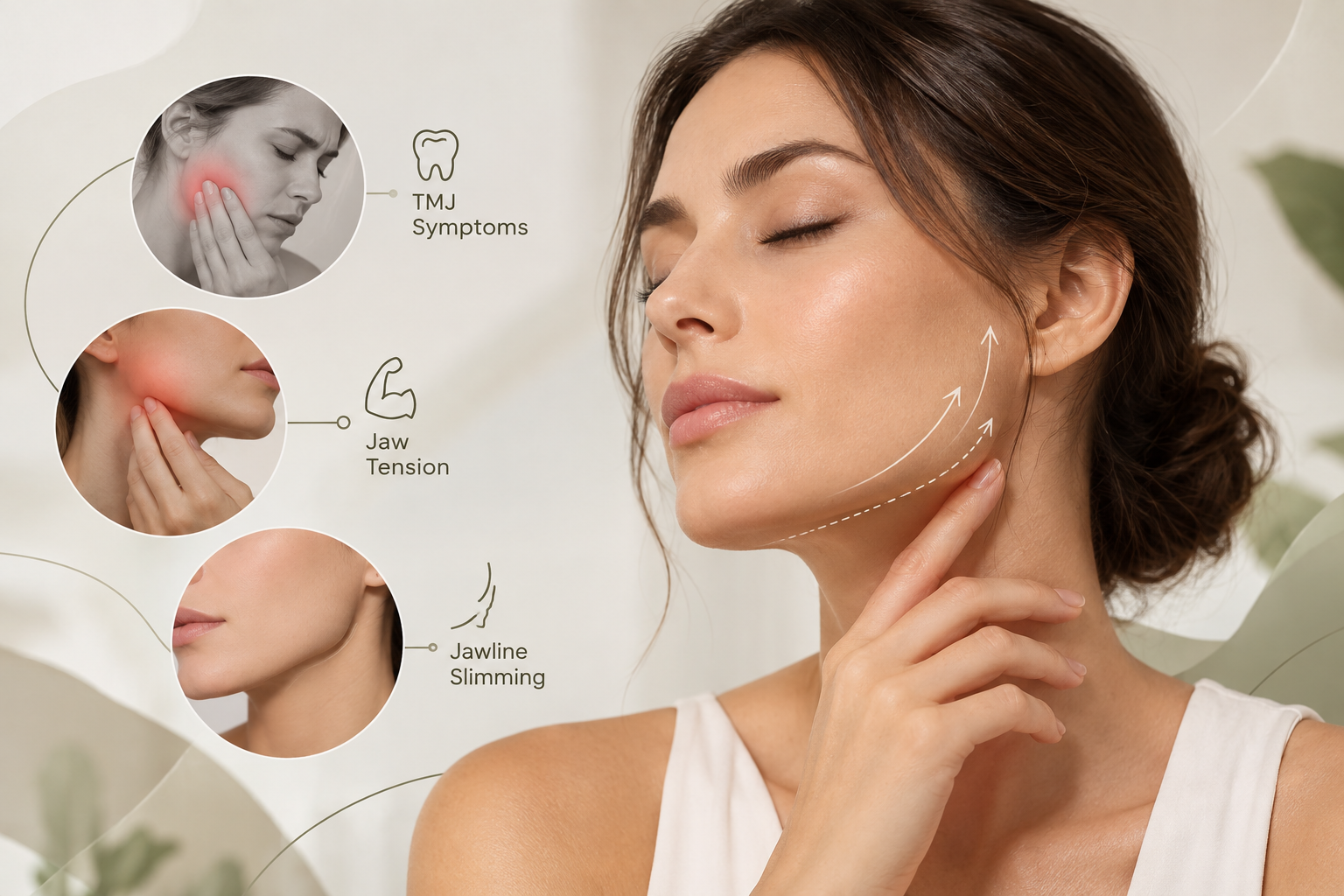
Masseter Botox involves placing botulinum toxin type A into the masseter, one of the main muscles used for chewing. Reducing activity in this muscle can serve two very different goals: decreasing excessive muscular force in selected patients with clenching or muscle-related jaw symptoms, and gradually reducing the prominence of enlarged masseter muscles to create a narrower-looking lower face.
Those goals should not be treated as interchangeable. Masseter Botox for TMJ is an oversimplified phrase because TMJ is the jaw joint, while TMD refers to a group of disorders that may involve the joints, chewing muscles, or both. Botulinum toxin is not FDA-approved specifically for TMD, and it does not correct every cause of jaw pain.
For cosmetic masseter prominence, recent randomized trials are more encouraging, but treatment remains temporary and results depend heavily on anatomy. If your lower-face width comes mainly from bone, facial fat, or skin laxity rather than muscle, reducing the masseter will not produce the same type of change.
What Is Masseter Botox?
Masseter Botox is a treatment that reduces activity in the masseter, a large chewing muscle running along the side of the jaw. Botulinum toxin type A works at the neuromuscular junction, reducing the chemical signaling that causes a targeted muscle to contract.
You can usually feel your masseter by placing your fingers near the angle of your jaw and clenching gently.
The muscle may become prominent because of natural anatomy, repeated activation, clenching or grinding, or a combination of factors. When the muscle is particularly large, sometimes called masseter hypertrophy or masseter prominence, it can add width to the lower third of the face.
Botox for masseter muscle treatment therefore changes muscle activity rather than directly changing bone, fat, or skin.
Why Do People Get Botox in the Masseter Muscle?
People generally investigate masseter muscle Botox for one or more of three reasons: excessive jaw muscle activity, selected muscle-related TMD symptoms, or cosmetic lower-face contouring.
Those goals often overlap. Someone who clenches heavily may develop prominent masseter muscles and also dislike the resulting width of the lower face. Another patient may have prominent masseters but no pain or grinding at all.
The first step should therefore be deciding what is actually being treated.
A functional plan asks, “Which symptoms are linked to this muscle?”
A cosmetic plan asks, “How much of the lower-face width is coming from the muscle?”
Masseter Botox for TMJ and TMD Symptoms
TMJ Botox is a popular search phrase, but it is medically imprecise.
TMJ means temporomandibular joint. TMD means temporomandibular disorder or disorders. NIDCR describes TMDs as more than 30 conditions that may involve the jaw joints, the muscles used for chewing, or associated headaches.
That distinction matters because Botox for TMJ does not repair the joint itself.
If pain is primarily associated with overactive chewing muscles, reducing muscular force may help some patients. If the problem involves a displaced disc, inflammatory joint disease, arthritis, locking, structural damage, or another source of facial pain, weakening the masseter does not correct that underlying problem.
The evidence is therefore condition-dependent.
A 2024 umbrella review found that botulinum toxin A reduced pain more than placebo in myogenous TMD, but did not outperform standard treatments overall. The authors also noted adverse-effect concerns and recommended considering it after other approaches rather than automatically using it first.
NIDCR similarly recommends beginning with simple, conservative care for most TMDs. Its guidance notes that botulinum toxin type A is not FDA-approved for TMD and that study results remain mixed.
That makes accurate diagnosis more important than the phrase “TMJ Botox.”
Masseter Botox for Jaw Tension and Jaw Clenching
Botox for jaw tension works by reducing the force the treated masseter can generate. This can be relevant when muscle overactivity is contributing substantially to tightness, fatigue, or soreness.
The same principle applies to Botox for jaw clenching.
A person who frequently clenches may notice:
Jaw fatigue.
Morning muscle soreness.
Tenderness along the sides of the jaw.
A feeling that the jaw is constantly “working.”
Increased masseter prominence.
Reducing contraction strength, however, is not the same as identifying why the clenching occurs.
Awake clenching can be affected by behavioral patterns, stress, concentration habits, and other factors. Sleep-related activity has its own clinical context. Treating the muscle may reduce force without eliminating the behavior that activates it.
That difference should be explained before treatment because it changes what “success” means.
Masseter Botox for Teeth Grinding and Bruxism
Bruxism is repetitive activity of the masticatory muscles that may involve clenching, grinding, or bracing of the jaw.
Because the masseter helps generate biting and chewing force, it can play a major role in bruxism. This explains why Botox for teeth grinding and Botox for bruxism have become common treatment searches.
Botulinum toxin may reduce the force generated during these muscle contractions. Some reviews have reported reductions in bruxism-related activity, pain, or bite force, although the evidence base varies in quality and bruxism itself can have multiple contributing factors.
For severe bruxism that has not improved with other measures, Mayo Clinic notes that Botox injections may be considered in some patients. Other management may include behavioral approaches, jaw relaxation, management of contributing medical or sleep conditions, and dental protection where appropriate.
The useful distinction is simple: botulinum toxin can decrease the force of muscle contraction. It does not necessarily remove whatever is triggering the clenching or grinding.
Masseter Botox for Jawline Slimming and Facial Contouring
When the masseter muscle has hypertrophied from chronic overuse, it adds physical bulk at the jaw angle on each side, creating a square, wide, or heavy lower face, sometimes described as a "boxy" jawline.
By reducing masseter activity, botulinum toxin initiates disuse atrophy, the muscle fiber volume decreases from lack of forceful use. As noted above, this process also involves partial fatty infiltration of atrophied muscle tissue, contributing to volume reduction. Over weeks, the masseter physically shrinks.
The cosmetic result is a gradual narrowing of the lower face, often described as a more tapered, oval, or V-shaped facial silhouette. The change can also make cheekbones appear more prominent relative to the lower face.
A Phase 3 trial of onabotulinumtoxinA reported a mean reduction in lower facial width of 5.24 mm at Day 90 compared with 0.04 mm for placebo in patients with marked or very marked masseter prominence. Improvements remained evident through Day 180. That result comes from a specific study population and treatment protocol and should not be presented as the result every patient will achieve.
Important expectations:
Results are not immediate, the slimming effect takes weeks, not days
Functional relief from clenching often appears weeks before visible facial slimming, because relaxing muscle contraction force is faster than the physical reduction in muscle size from atrophy
The degree of visible change depends significantly on why the lower face is wide, covered in the next section
What Masseter Botox Cannot Change: Bone, Fat, and Skin
Masseter reduction changes the muscle. It does not physically narrow the jawbone. It does not remove facial or submental fat. It does not tighten loose skin. And it does not add definition to a small or recessed chin.
This distinction is one of the most important parts of assessing a masseter Botox jawline treatment.
A wide lower face can come from several anatomical components at the same time:
| Source of Lower-Face Width | Would Masseter Botox Directly Treat It? |
|---|---|
| Enlarged masseter muscle | Potentially |
| Wide mandibular bone | No |
| Facial or submental fat | No |
| Skin laxity | No |
| Chin projection | No |
| Combination of factors | Only the muscular component |
If jaw width is predominantly skeletal, weakening the masseter may create a smaller change than expected.
Functional vs Cosmetic Masseter Botox
| Factors | Functional Goal | Cosmetic Goal |
|---|---|---|
| Primary concern | Muscle tension, clenching, grinding or selected muscular symptoms | Wide or square lower face caused substantially by muscle |
| Assessment | Symptoms, diagnosis, muscle tenderness, clenching history, dental or jaw findings | Masseter prominence, symmetry, facial width, skin and skeletal proportions |
| Desired change | Lower muscular force or discomfort | Less masseter prominence |
| Success measure | Symptoms and function | Facial proportions and lower-face width |
| Timing | Muscle effects may be noticed before contour change | Visible slimming develops gradually as muscle prominence decreases |
| Main limitation | Does not correct every cause of TMD or bruxism | Does not narrow bone or remove fat |
One patient can have both goals. They should still be evaluated separately.
Who May Benefit from Masseter Botox?
Candidacy is always determined by professional evaluation. General factors that may make someone a reasonable candidate include:
Enlarged or hypertrophic masseter muscles confirmed on clinical examination, the key criterion for cosmetic candidates.
Jaw clenching that causes muscle soreness, fatigue, or morning discomfort.
Teeth grinding (bruxism) contributes to tooth wear, jaw soreness, or headaches.
Muscle-based jaw tension where symptoms appear to originate from muscle overactivity rather than joint pathology.
Lower facial width due substantially to muscle bulk rather than jawbone or fat.
Realistic expectations: results are temporary and gradual; Botox addresses the muscle without eliminating the cause of overactivity.
A consultation at Skin Theory Aesthetics includes a clinical assessment of your masseter muscle, a discussion of your goals and symptoms, and an honest evaluation of whether this treatment is appropriate for your anatomy and presentation.”
What Happens During a Masseter Botox Appointment at Skin Theory Aesthetics?
The appointment should begin with assessment rather than injections.
A clinician may review:
Why are you seeking treatment?
Your medical history and medications.
Previous botulinum toxin treatments.
Jaw symptoms, if present.
Facial and lower-jaw anatomy.
Masseter size and symmetry.
How the muscle changes during clenching.
Whether your goal is functional, cosmetic, or both.
Expected benefits and limitations.
Risks, alternatives, and follow-up.
The treatment itself involves injections into the planned area of the masseter.
A responsible patient guide should not prescribe a universal injection map. Masseter anatomy, nearby facial-expression muscles, dose, depth, and placement all affect safety and results.
How Many Units of Botox Are Used in the Masseter?
This is a high-interest question, and the honest answer is: it depends, and no single number is universally correct.
The masseter is a large, powerful muscle, significantly larger than the muscles treated for forehead lines or crow's feet. Higher doses are required to achieve meaningful results.
Published clinical research provides a reference range:
A review of medical literature from an Allergan Phase 2 clinical trial found reported doses ranging from 10 to 100 units per masseter across published studies, with a mean of approximately 38 units per masseter.
A dose-finding study found an optimal range of 48 to 72 units total (both sides) for cosmetic masseter prominence reduction.
A 304-patient bruxism study used 25 units total bilateral and produced significant reductions in muscle activity.
In general clinical practice, total doses commonly range from 40 to 80 units total (both masseters combined), depending on: muscle size and degree of hypertrophy; biological sex (males typically require higher doses); functional vs. cosmetic goal; the specific botulinum toxin product used; and prior treatment history.
Note: Units from different botulinum toxin products cannot be compared directly. For example, the dosing relationship between Botox and Dysport is not one-to-one, 40 units of Botox (onabotulinumtoxinA) is not equivalent to 40 units of Dysport (abobotulinumtoxinA). Always clarify which product was used when comparing quotes or results.
At Skin Theory Aesthetics, dosing is determined during your consultation based on clinical assessment of your masseter, your goals, and your product history.
When Does Masseter Botox Start Working?
The functional effect and cosmetic effect do not necessarily appear at the same time.
Botulinum toxin begins changing neuromuscular activity before a visibly enlarged muscle has had time to reduce in size.
That means someone may notice less force or tension before noticing a narrower face.
For cosmetic masseter prominence, major recent trials have commonly assessed the primary visible outcome at around Day 90. Phase 3 data showed meaningful lower-face and masseter-prominence changes at that time.
Patients should therefore avoid judging a jaw-slimming result based only on the first several days after treatment.
How Long Does Masseter Botox Last?
Masseter Botox is temporary.
As neuromuscular activity returns, the masseter can regain strength and prominence.
Duration varies with the product, dose, muscle characteristics, treatment goal, and individual response.
In the recent Phase 3 cosmetic study, improvement in masseter prominence remained evident through Day 180 after treatment. That does not guarantee six months of identical results for every patient or every botulinum toxin formulation.
For functional symptoms, the relevant question is not only when muscle activity returns, but whether the original contributors to clenching, bruxism, or pain are still present.
What Results Can You Expect?
Jaw tension and clenching
Selected patients may experience reduced force or muscular tension. The result depends on whether the masseter is actually an important contributor to the symptoms.
Pain-related outcomes
Some studies suggest pain reduction for myogenous TMD compared with placebo, but botulinum toxin has not consistently outperformed established conservative treatments.
Jawline slimming
Patients with genuine masseter prominence may experience measurable reductions in muscle prominence and lower facial width. Recent randomized evidence supports this effect.
Someone whose jaw width comes mainly from bone may see much less cosmetic change.
Risks and Side Effects of Masseter Botox
Masseter treatment is not simply wrinkle Botox moved lower on the face. The masseter is an important chewing muscle surrounded by structures involved in facial movement.
Potential effects reported in the literature include:
Injection-site discomfort.
Bruising.
Temporary chewing weakness or fatigue.
Uneven muscle response.
Facial asymmetry.
Smile changes.
Undesired contour change.
Paradoxical masseter bulging.
Local weakness.
Urgent Medical Attention:
If you experience difficulty swallowing, breathing, or speaking after treatment, seek immediate medical attention.
If facial asymmetry, smile changes, or other unexpected effects persist beyond 2 to 3 weeks.
If injection-site pain or swelling worsens rather than improves.
Does Masseter Botox Cause Jowls or Facial Sagging?
Masseter reduction can change facial support and proportions because a previously prominent muscle contributes volume to the lower face.
There are published reports describing facial flaccidity or sagging after masseter botulinum toxin treatment, particularly in patients with reduced skin elasticity or existing soft-tissue laxity.
That is different from claiming that Masseter Botox routinely “causes jowls.”
A person’s visible response can depend on:
Existing skin laxity.
Age-related changes.
Baseline facial volume.
How large the masseter was before treatment.
Skeletal proportions.
How much muscle reduction occurs.
This is one reason cosmetic assessment should include the whole lower face rather than only the size of the masseter.
Masseter Botox vs Other Options for Jaw Tension or TMD
NIDCR recommends starting with conservative treatment for many TMDs because symptoms may improve without invasive or permanent procedures.
Depending on diagnosis, options may include:
Temporary dietary modification.
Heat or cold.
Jaw exercises.
Reducing habits such as clenching or gum chewing.
Physical therapy.
Behavioral approaches.
Biofeedback.
Medication when clinically appropriate.
Intraoral appliances in selected patients.
No treatment should be described as universally better because different TMDs have different causes.
Botulinum toxin is better framed as one possible tool for selected patients, particularly when excessive muscle activity is an important part of the clinical picture.
How Much Does Masseter Botox Cost?
Cost usually depends on the product, number of units, anatomy, treatment goal, provider, and location.
Skin Theory Aesthetics’ current Botox cost guide states that Botox is priced at $15 per unit. The same page lists masseter or jawline treatment for TMJ-related use as “varies by patient” and quotes the treatment after consultation rather than publishing a fixed package price.
That is more appropriate than estimating a fixed Masseter Botox price without first knowing how much product is clinically appropriate.
Pricing can change, so patients should confirm the current rate during consultation.
Is Masseter Botox Worth It?
It can be reasonable to discuss Masseter Botox when the treatment matches the problem.
For cosmetic treatment, that generally means the masseter contributes meaningfully to lower-face width.
For functional treatment, it means excessive masseter activity is likely contributing to symptoms and the treatment fits into a broader diagnosis and management plan.
It may make less sense when facial width is primarily skeletal, when skin laxity is the main concern, or when unexplained jaw pain has not been properly evaluated.
The best decision is not based on whether Masseter Botox “works” in general.
It is based on whether reducing this specific muscle is likely to help your specific problem.
Considering Masseter Botox in Mount Kisco?
Skin Theory Aesthetics offers Botox treatment in Mount Kisco, New York, with treatment performed by the practice’s board-certified Nurse Practitioner. The practice states that consultations include review of facial movement, anatomy, and treatment goals before an individualized Botox plan is created.
If your main concern is cosmetic jaw width, a consultation can help determine whether the masseter is actually contributing enough bulk for muscle reduction to make sense.
If your main concern is unexplained jaw pain, locking, significant clicking, or dental damage, the underlying cause should be evaluated appropriately before assuming the problem is simply an overactive masseter.
Frequently Asked Questions
Does Masseter Botox help TMJ?
Masseter Botox for TMJ may help selected patients whose symptoms are substantially related to overactive chewing muscles, but it does not treat every temporomandibular disorder. TMD can involve muscle, joint, disc, structural, and other conditions, so diagnosis matters. Current evidence suggests possible pain benefits for myogenous TMD, but results remain mixed.
Is Botox FDA-approved for TMJ?
No. Botulinum toxin type A is not FDA-approved specifically for treating temporomandibular disorders. NIDCR explicitly identifies its use for TMD as unapproved and notes that evidence remains mixed.
Does Masseter Botox slim your face?
It can reduce lower-face width when prominent masseter muscles are an important source of that width. Randomized studies have shown reductions in masseter prominence, muscle thickness, and lower facial width. It cannot directly narrow the jawbone or remove facial fat.
How long does it take for Masseter Botox to slim the jaw?
Jaw slimming is gradual because visible contour change depends on reduction in muscle prominence, not simply the first neuromuscular effect. Recent cosmetic trials commonly evaluate major visible outcomes around Day 90. Individual timing varies.
Does Masseter Botox hurt?
The procedure involves injections, so brief discomfort, tenderness, or bruising can occur. Pain tolerance varies. Injection-site reactions are among the recognized effects of botulinum toxin injections.
Can Masseter Botox affect chewing?
Yes. Because the masseter is an important chewing muscle, reducing its contraction strength can temporarily make prolonged or forceful chewing feel weaker or more tiring. This is one reason treatment should aim to reduce excessive activity without unnecessarily compromising function.
What happens when Masseter Botox wears off?
Muscle activity gradually returns as the neuromuscular effect diminishes. Clenching force, symptoms, or masseter prominence can also return, depending on the reason the muscle was active or enlarged in the first place.
How often can Masseter Botox be repeated?
There is no universal schedule that is appropriate for every patient. Repeat timing should consider return of muscle activity, treatment goals, product labeling, previous response, adverse effects, and whether continued treatment remains appropriate.